#thandai2
Saturday, 29 October 2022
#thandai ankle cuff
Monday, 1 August 2022
Aadiperuku #chapparathatti & #bangala rathyatra
The #Aadi_Perukku festival celebrated on 18th day of the Tamil month of Aadi ( july- August ) to welcome fresh waters into the rivers and canals was celebrated with religious fervour and enthusiasm by people in delta region of tamilnadu Attired in their best women visited bathing ghats along the Cauvery, #Kollidam and Grand Anicut canal in the delta districts and offered pujas to Mother #Cauvery. Youth and Children use took bath and enjoyed the fresh water in the rivers by jumping into it from bridges and bathing ghats. On this day those who got married recently offered special pujas at the river banks. Although most part of the rituals were oriented towards woman, boys too had their share of joy in the festivity.Children pulled #chapparams (miniature chariots) made from discarded timber pallets carrying the images of Hindu gods and goddesses along the streets in their villages as part of the celebrations in Delta region especially in kumbakonam tanjore belts.
These toys were colloquially known as #sapprathatti which looks like a chariots. This toy car play ( #sapparam ) has a traditional continuity in Tamil literature. #Pillai_Tamil is a genre of tamil literature which celebrates the childhood of the hero or deity on whom it is being sung. This genre divides the period of childhood into 10 stages. The first seven stages Kappu, Senkeerai, Thalaatu, Chappaani, Mutham Ambuli and Varugai are the stages common to both male and female children. Last Three stages will be diffrent for boys, sittril, siruparai, #siruther. At the age of 21 months the child would play with a small chariot made of wood is know as Siruther Paruvam butGrammatical Commentary' states that this season occurs in the child's seventh year.Nowadays siruther were made in the form of #olaichapparam / #theruvadchan. However it would we could see this tradition is still preserved and exists in delta region.
In the other hand of this collage we could see similar tradition practice happening in West Bengal. Rathyatra is about a week-long festival large number of people gather at the time of yatra. #Rathyatra which is the third important festival in Bengal after #Durga_Puja and #Kali_Puja. #Rathyatra of West Bengal is the second oldest chariot festival in India after the Rathyatra of Puri. At Balaram mandir of Ramakrishna Mission the festival will be held in a grand manner. Every year thousands of devotees and monks used to pull the rath which had once pulled by Sri Ramakrishna.
The famous rathyatra festival of #Mahesh in #Hooghly district will be held with thousands of devotees used to gather to pull the ratha. This celebration mainly takes place in the months of June or July. During this festival time we could find toy chariots were sold at every street corner ahead of Rath Yatra in the west Bengal a week before the festival this time. The small, one- or two-storey chariots made of plywood, scrap-wood and colourful papers. Rath Yatra children in almost every neighbourhood are seen pulling the small chariots, accompanied by their grandparents or parents and friends. We could see this practice in Bangladesh hindu villages too.
--- #Ramu.Rm.N
Wednesday, 8 June 2022
#Adukkupavadai
Tuesday, 31 May 2022
பொன்னிலவு
Tuesday, 12 April 2022
சித்திரை திங்கள் 22
| சுபகிருது | (நற்செய்கை) |
Tuesday, 5 April 2022
#Crocodile_holding_Fish
Saturday, 2 April 2022
Maharanathu
#Naths are more elaborate nose rings worn mostly during weddings or other important grand events were as a nose stud is worn on a regular basis. From the 15th century onwards the #nath became quite popular with variations like clove, rings, flowers and its made of pearls, sapphire, emerald and kundan. In tamil nadu we could see the usage of naths with the Royals and court dancers. In temples we could see the naths were made in the shape of mahra we can call them as maharanathu. In this collage we could see the #mahara_nathus were been used for processianal deities of #srivilliputhur, #sreeperumputhur, #kanchipuram and #mylapore is compared with a #Gargoyle. At the time of annual festivels in tamilnadu temples we could see the usage of these fine crafted nose pins were adorn by the processional female deities.
Traditionally a makara is considered to be an aquatic mythical creature it is generally depicted as half terrestrial animal in the frontal part (stag, deer or elephant) and half aquatic animal in the hind part (usually of a fish, though even a floral tail is depicted). Though Makara may take many different forms throughout Hindu culture in general its form is always related to appears as a #Gargoyle.
Mahara most commonly recurring creature in Hindu temple architecture and iconography. Makara is also the emblem of #Kamadeva (the god of love and desire). Kamadeva is also known as #Makara_Ketu. Its represented as the vahana of #Ganga (the river goddess) and #Varuna( god of the water and the ocean and guardian of the west). Makara shaped earrings called #Makarakundalam were worn by the Hindu deities
---Ramu.Rm.N
Monday, 21 March 2022
Rishaba vahanam & north tamilnadu desi breeds
Structural comparison with native cattle breeds of Northern TamilNadu and Temple Rishaba vaganam. During the annual festivel on the fifth day of the celebration is very important as the presiding deity of the temple Lord shiva use to come out in the Rishava vahanam.The disciplined bull, which is calm and docile, symbolizes Dharma, an image of controlled power.The white color of the bull symbolizes purity and justice. Generally in thondaimandala (northern TamilNadu )style rishabam vaganams were use to be designed as short and majestic with a broad forehead and short horns similarly which will look like indigenous breed ( kanchipuram kuttai /Thondainadu kuttai ).
Here in this comparison we had taken some prominent temple vahanas in northern Tamilnadu like #Mylapore, #kanchipuram and #Tiruvannamalai. In the other hand we could see the pictures of the native bulls of the northern tamilnadu which is commonly know as Thondainadu kuttai / kanchipuram kuttai is a desi breed and excellent drought variety This is short breed grows to 80-100 cms in height. It can withstand the hot humid and sultry climate of North coastal Tamil Nadu. This is very docile and amiable and it has an average milk yield of 2to3 litres/day. Generally they are Red, White, Black and mixed colours. This breed is endangered and there are only a 600 - 700 cows available currently and they face an imminent threat due to artificial insemination and lack of interest in protecting and preserving this breed. These indigenous breeds were commonly found in Chittoor, nellore in (A.P), Velur, thiruvallur, Chengalpattu, Chennai, kanchipuram, Vilupuram and Tiruvannamalai districts of Tamil Nadu.
----Ramu.Rm.N
Tuesday, 1 March 2022
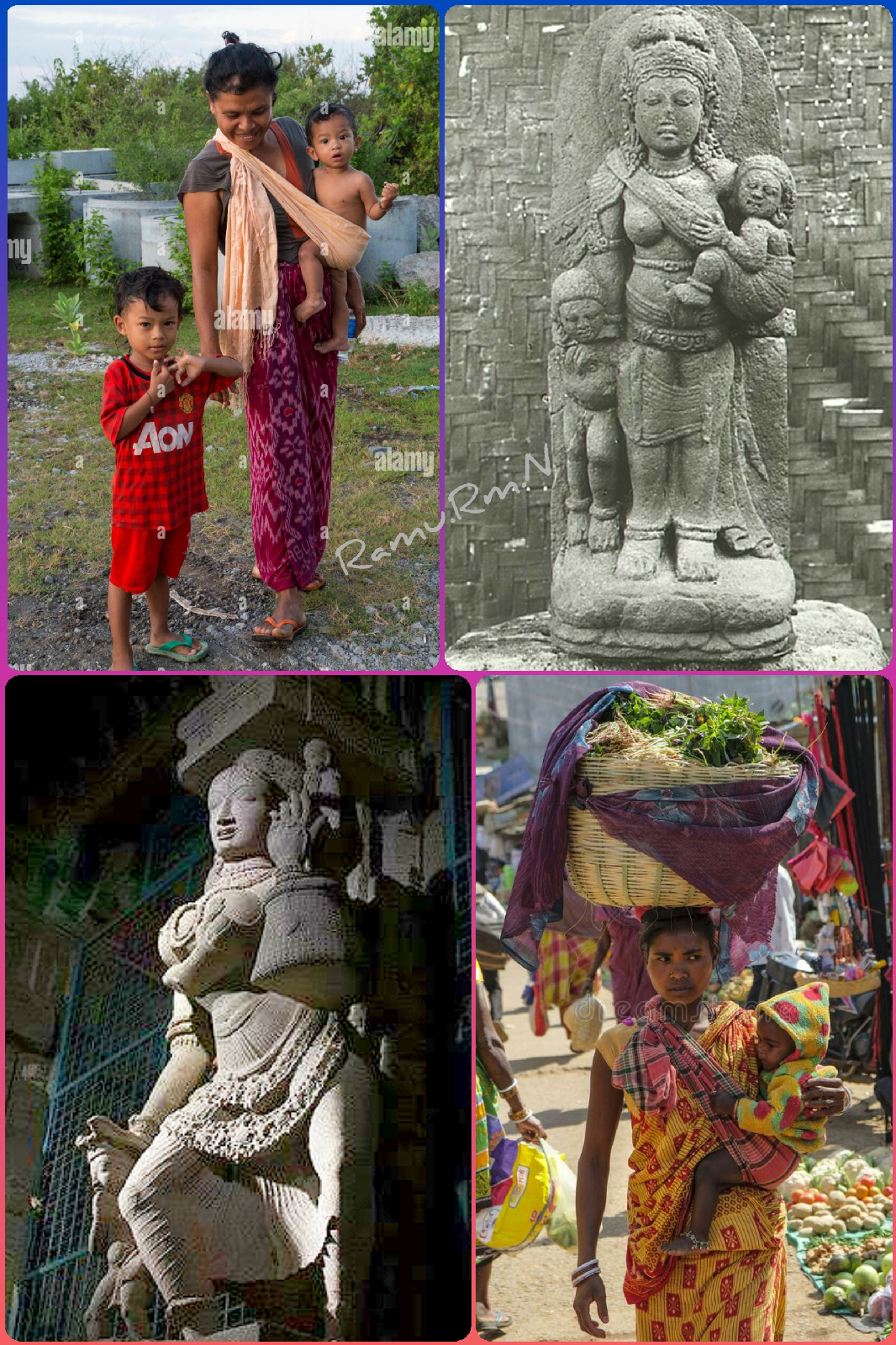
Traditional baby carriers
Babywearing techniques include wrapping the child on the chest attaching them to the side of the body with slings that range from traditional, colorful fabrics passed down through generations to generation. According to the region the way of carrying may vary like baskets, cradle boards, cloths and in certain regions carrying them on the back.
Here in this sculpture we could see a two armed Mother Goddess ( Brajut / hariti ) holding a elder one in his hand and carrying the Youngest in a Shoulder sling. This was 9 th century sculpture of the goddess Brajut / hariti from desa Claket_Jabung, #Indonesia is included here to show the way some traditional baby carriers are been used historically and this way of carrying exist in the rural parts of south Asian countries. Here in this collage we could see the simalar way of baby carried in the shoulder sling made of fabric which were from India and Bali, Indonesia. The #Balinese Mother and Children Carrying the Youngest in a Shoulder-sling and holding the elder one in his hand.
In the other half we could see the similar sculpture from #Madurai meenakshi Amman temple in south TamilNadu, India. This sculpture was made during nayaka period in this we could the mother with her three childern. She hold her elder one in his hand carries her younger one in her shoulder and she carries the other in her shoulder which looks like the Indonesian women ( hariti ) sculpture however the way of carrying the children was almost similar. In the other side we could see a recent picture of tribal woman from the #Kondh_tribe with her child in a sling shopping vegetables in the Koraput market in #Odisha, India.
The mythology of #Hariti is Buddhist in origin and dates back to Gandhara period (3rd century of the common era). The concept was popular in Northwestern India and the adjacent areas of Pakistan and #Afghanistan. The spread of the concept/mythology and the fact the story and form have remained unchanged for such a long time worshipped as the protector of children.
Hariti married to #Yaksha Panchika lived in Rajagriha with her five hundred children. But she used to eat other children in Rajagriha. When Buddha was informed of what is happening he hid one of Hariti’s children. When distraught Hariti met Buddha and she narrated her story of her missing child.#Buddha pointed it out if missing one of five hundred children can cause so much mental agony what would be the case of mothers who lost her only child. With that Hariti realized her mistake and wanted to be the protector of children, easy delivery and happy child rearing, while her negative aspects include the belief of her terror towards irresponsible parents and unruly children.
--Ramu.Rm.N
Wednesday, 16 February 2022
Malaccan version of Thaipusam
Penang silverchariot and thaipusam
Sunday, 13 February 2022
musical instruments
Saturday, 12 February 2022
elephants now & then
#Elephants occupy a special place in the life and art of India.As elephants are known for their intelligence and smartness. Their legendary attributes of strength, intelligence, smartness, nobility and longevity are eulogized in myth, epic and popular literature. In the figural and decorative arts, elephants provide an enduring fascination. At centuries-old temples, monastries, forts and palaces, elephants flank ceremonial entrances, enrich columns and capitals, form balustrades to stairways or stand as enigmatic sentinels of vast courtyards. Here in this we could see a #hosaylsa period relif sculpture in the pillars of #srirangam #ranganathar temple at tamilnadu. In this we could notice the well decorated tusker is trying to shows amazing strength by breaking the branch of the tree.
In the other hand we could see the
#Inventive African elephant Teetering on its two feet to reach a tasty meal high up in the trees, the hungry beast backed up onto his hind legs before stretching out his long trunk and tearing down some of his favourite acacia leaves to snack on in South #Luangwa National Park, #Zambia.
#Ramu.Rm.N
Sunday, 30 January 2022
#Elephant_circus
A beautiful lively #nayaka period sculpture from Thirukurungudi nambirayar temple. #Thirukurungudi is a town which is located in #Tirunelveli district Tamil Nadu South India. In this they had shown the #elephant circus play and surrounded buy the #jugglers and #mahot. A well decorated fit tusker stands in two legs in a small #pedestal and holds a pot in his trunk. In the other hand we could see the similar practice happens till date but mostly femal Asian elephants are trained used for entertainment in circuses activities in this picture we could see the similar activity in most of the circus in the globe. This picture was taken from the #Natraj_Circus company which is from #Kolkata West Bengal.
Friday, 17 December 2021
#Nelithandai ( #நெளிதண்டை )
Thandai is a Tinkling ankle-rings worn by Men and Women in traditional style. These stiff anklets are adjustable and easy to wear at legs. Still we could see the usage of the ankle rings were exist in the rural parts of India. The ankle rings were used in different shapes in all over India and according to the shapes the name of the ankle rings may differ partially. In this pictures we could see the similar ornaments which is in the zig zak shaped ankle rings were shown in the sculpture which was the contribution by Hoysala (king Ramanatha period) - 13th/14th century AD to the Venugopala shrine at #Srirangam temple #Trichy which has the Thematic representation from Pasurams of Thirumangai Alwar.
In the other hand we could see the continuation of the zig zak ankle rings were shown in #nayaka period #dwarabalaks ( door guardian ) stuco from Tanjore brihadeshwara temple. We could see the gigantic stucco door guardians at the periya nayaki ambal shrine.
Here in this instance which shown below shows the precious stone studded golden zig zak ankle rings from #avudaiyarkovil temple in pudukottai district which is used to adorn by the processional deity #manikavasagar along with all jewelleries used during annular festival occasions could be a martha era and also in another part a similar silver neli thandai were quit commonly used till early 20th century so from these pictured could understand the usage of ankle rings from deity to the common public is quite common and also similar pattern do exist for some centuries too.
-- Ramu.Rm.N
#comparison #jewelry #Indian_jewelry #continuation #ankle_rings #zigzag
Friday, 12 November 2021
dheki
#Dheki is a traditional agricultural tool used for threshing to separate rice grains from their outer husks, while leaving the bran layer, thus producing brown rice in many villages women folk do this work exceptions are everywhere but work of preparing rice/paddy for family rests in hands of women this is also innovation evolved in rice producing areas in West Bengal and Bangladesh.
In the other hand a terracotta panel from temples in west Bengal which represents the Bengali dhnekis or rice thresher in the village of #Ganpur in central #Birbhum district. In #Bengali folklore the iconography of narada muni is related with flying dhneki as his vehicle. We could see such kind of terracotta panel in Assam westbengal and Bangladesh.
This panel is from a temple in Uchkaron in #Birbhum district. This scene is also depicted in terracotta temples around Goghat in #Hugli district.
--- Ramu.Rm.N
Wednesday, 10 November 2021
ottiyanam gridls
#ottiyanam 3
south india rigid waist belt were commonly known as #Oddiyanam the very purpose of the Girdles encircle the attire and which holds the bottom piece of clothing, that complements the texture of traditional outfits.
Here in this instance which shown below shows the another style of golden girdle from #melkote thirunarayanapuram temple which is used to adorn by the processional deities upayanachiyars along with all jewelleries used during annular festival occasions and also in another part a late 19 th century photograph of a south India women from Tamilnadu is shown on which a lady adorned with Victorian Edwardian 1837-1910 era south Indian golden jewelleries among which similar magnificent griddle also we could witness girdle ( ottiyanam ) so from these pictured could understand the usage of griddle from deity to the common public is quite common and also similar pattern do exist for some centuries too.
-- Ramu.Rm.N
Thursday, 24 June 2021
#Gangireddu_aatalu
#Gangireddu with tinkling bells on its fore feet attired in layers of red and yellow mirrored clothnods its head vigorously to the tunes of its master who visits every house in a village and collects cash, materials and food grains donated by people. From silk sarees to cotton fabrics, people express gratitude for a good harvest by draping a plethora of garments on its back. With hopes of a better yield next year they bid farewell to the bull of good fortune.The return of Gangireddu to the villages is considered a good sign for the newly-married couple.The bull dances and performs acrobatics on the instruction of its master to entertain the crowd.
During Sankranti has been a common site in the villages of #AndraPradesh and telungana which marks the beginning of the harvest festival #Sankranti.
In fact Gangireddu #Aata is perhaps one of the very few rural entertainment that has survived through times. The century-old art form has spread to neighbouring States of #TamilNadu and #Karnataka, apart from other parts in the State. In tamilnadu they call as boom #boom #madu and in Karnataka they call as gangireddu #basava. In this collage we could see the 16 th century sculptures of gangireddu atta in #Thirukurungudi temple at #thirunelveli dist, #Tamilnadu. From this we could see understand the continuity of the tradition had existed in tamilnadu also we could see the tradition and its still exist in telugu States.
-- Ramu.Rm.N
Sunday, 6 June 2021
#Sahasraradalapadmam
#Sahasraradala #padmam
--Ramu.Rm.N
Friday, 4 June 2021
Jambhala /kubera
In hindu mythology Kubera is believed as the god of wealth, demigod and Yaksha. He is regarded as He is regarded as the regent of the North ( one amoung the asta dikpalagas ). In Buddhist tradition they call him in the name of Vaishravaṇa or #Jambhala /#Lokeshvara. The Buddhist #Vaisravana like the Hindu Kubera is the regent of the North a #Lokabala and the Lord of #Yakshas. He is one of the Four Heavenly Kinga each associated with a cardinal direction. He is worshipped as God of prosperity and wealth by Asian people. This is a the four-armed Kubera sits on a lotus flower supported by a money pouch that is bound by chains of jewels. Its right foot rests on a few money pouches. There is a money pouch on each corner of the pedestal and six pouches on each side, representations, gods, demigods, heroes, etc. This one of beautiful javense miniature bronze idol which is dated to 850 - 930. And its height is 11.5 cm. Currently this Jambhala bronze idol is displayed at #Rijksmuseum in Amsterdam, #Netherlands.
#Ramu